

About us

Discover the Virhox Team

University of Padova

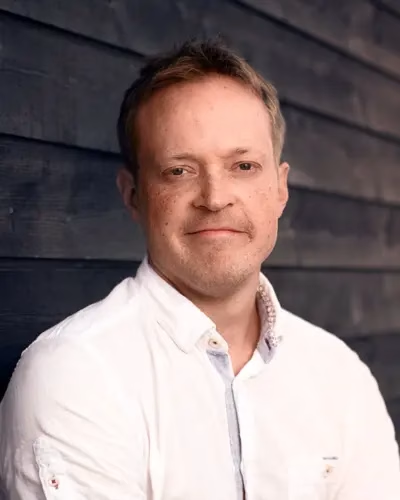
Dr. Umberto Rosani

Sample Image


In our laboratory we are interested in the molecular interplay between viruses and hosts.
We are researching in the field of molecular biology and, by developing high-throughput sequencing approaches, we aim to investigate viral and cellular genomics, transcriptional regulation and RNA modifications.

The VirHoX project has a very clear objective. It will simply exploit what viruses are doing, i.e. hailjacking host cellular machinery, to disentangle their associations with hosts. Our involvement in the VirHoX project as coordinator will challenge us to amalgamate the results of the project’s team into a single tool, and benchmarking it for different combinations of viruses and hosts

PARTNER

Pasteur institute

Sample Image

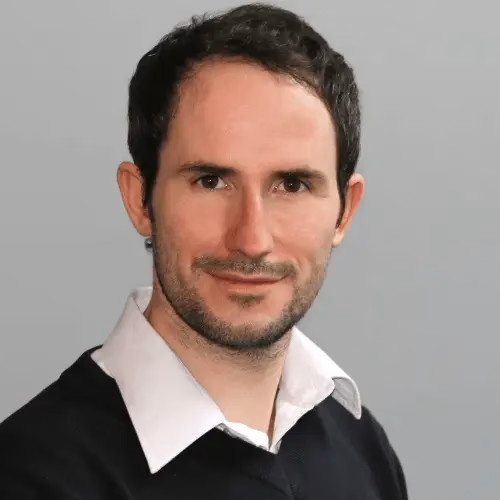
Our group addresses fundamental questions at the interface of microbiology, virology and evolution. We use viruses infecting archaea as a model system, because these represent one of the least explored components of the global virosphere. Our research aims to uncover the archaeal virus diversity across different habitats and study the key aspects of their biology, including virus-host interactions, replication strategies, and evolutionary dynamics.

Within the VirHoX project, we will evaluate the developed technology using several archaeal virus-host model systems. In parallel, to study archaeal virus-host interactions in ecologically relevant contexts, we will apply this technology to natural virus-host communities recovered from hot spring samples.

ISTA

Prof. Carrie Bernecky

Sample Image

Our laboratory focuses on understanding the mechanisms of transcriptional and post-transcriptional regulation of RNA. As part of our research program, we have a strong interest in the RNA-dependent mechanisms by which host organisms protect themselves from pathogens. We apply biochemical approaches to purify and reconstitute protein and protein-RNA complexes. We analyze these complexes using a combination of in vitro biochemistry and cryo-electron microscopy to gain insights into RNA metabolism and gene regulation.

PARTNER

CNRS

Sample Image


The Hart team combines protein random library screening (e.g. phage display) with studies on structure and mechanisms of viral replication machines, focusing mainly on influenza virus. Located in the French national structural biology campus, use X-ray crystallography, cryo-EM, NMR and biophysical characterisation platforms in our studies.

Our role is to engineer enzymes to physically couple translating host ribosomes to the the messenger RNA of infecting viruses. Our starting points are natural enzymes with desired properties (RNA cleavage and ligation) and modifying these as tools to decode virus-host associations in complex samples.

partner

University of Trieste

Sample Image

Most of our research focuses on the early natural history of the invertebrate innate immune system (Bivalves and Crustaceans), with particular attention given to the genetics of antimicrobial peptides (AMP), pathogen receptors (PRR) and the relative signal transduction. Our long standing expertise on genomic data management paved the way for long term collaborations with colleagues interested in the comparative genomics of vertebrates, in particular fishes. In recent years, our collaborations have supported the analysis of both animal and plant biodiversity. For this purpose we apply both DNA metabarcoding and environmental DNA (eDNA) technologies.

Our role in the VirHoX project focuses on environmental microbiology combined with genomics and bioinformatics, applying the VirHo-seq approach to complex environmental samples. We contribute to the generation and bioinformatic analysis of high-throughput sequencing data to identify virus–host interactions and to interpret viral diversity and ecology in natural ecosystems.

PARTNER

University of Oslo

Sample Image


The focus of the Valen group is understanding translation, and particularly its regulation and why so many regions are translated that do not code functional proteins. To this end, we use a combination of experimental and computational approaches to develop methods and characterize RNA and ribosomes.

In VirHox our role is to facilitate the use of CRISPR-based approaches to RNA cleavage and to experiment with protocols to ligate the ribosomal RNA to the translated mRNA. In particular we bring expertise in ribosomes and translation to the VirHoX effort.

partner

FIZ

Sample Image

Dara Hallinan’s main research focus is on the interaction between law, new technologies and society. In this regard, his primary area of legal expertise is EU data protection law. He takes a specific interest in technological and social developments related to ICT and biotech.

FIZ Karlsruhe’s role in VirHoX is to provide an analysis of the legal framework relevant to the technology which will be developed to identify virus-host interactions. In particular, FIZ will analyze the relevant legal frameworks concerning EU data protection law, and IP law, and will, on the back of these analyses, elaborate policy proposals which will smooth the way to successful technological development and deployment moving forward.
industrial PARTNER

Eubiome

Sample Image


EuBiome focuses on research and clinical innovation in the veterinary microbiome, with a particular emphasis on fecal microbiota transplantation for dogs and cats affected by chronic enteropathies and inflammatory conditions.
Its work integrates microbiome profiling, clinical data, and ecological principles to develop evidence-based, personalized therapeutic strategies

EuBiome contributes to VirHoX by providing a real, clinically grounded host–microbiome case, enabling virus–host association analyses to be tested against real-world biological complexity. This contribution supports the project’s objective of moving from theoretical associations to functionally interpretable virus–host relationships.

Scroll to Top